
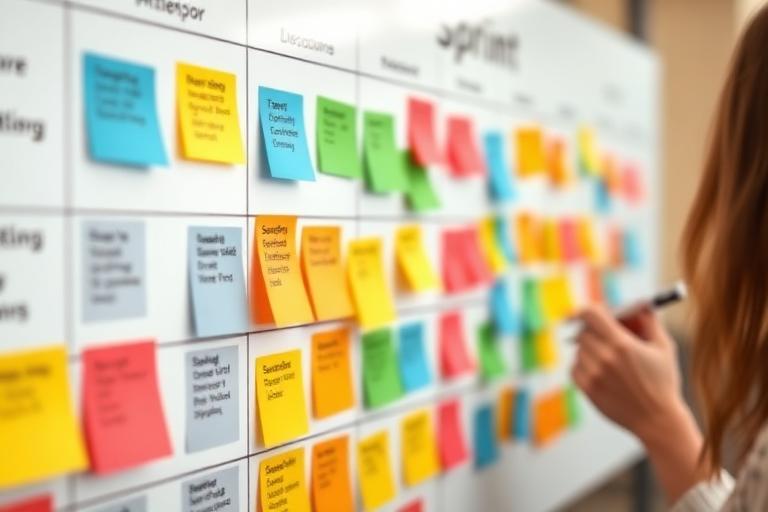
Blueprint Sprint: What Is It and How Does It Accelerate Product Development
A blueprint sprint is a time-boxed, facilitated workshop where cross-functional teams solve critical product problems and validate solutions in 3-5 days. You get the team in a room, map the actual problem (not the one you think you have), sketch solutions, build a realistic-looking prototype, and test it with real users. All before you write a single line of production code. The process started at Google Ventures. Product teams worldwide have adapted it since then because it solves one specific problem: you stop wasting months building features that miss the mark.
Why Blueprint Sprints Emerged
Product teams keep building features nobody wants. I keep thinking about this. Pendo did research in 2023 and found that 80% of software features are rarely or never used. The cost isn't just wasted development time. You lose opportunity cost, team morale takes a hit, and your market positioning suffers.
Traditional product development follows a waterfall pattern even when teams say they're agile. Requirements get written. Designs get approved. Engineers build. QA tests. By the time real users see the product, the team has burned 6-12 weeks. If the solution misses the mark? The sunk cost makes pivoting painful. Nobody wants to admit they got it wrong.
Blueprint sprints flip this whole model. They compress the learning cycle from months to days. Instead of building to learn, teams prototype to learn. The prototype feels real enough to generate honest user feedback. But it costs maybe 5% of what production development costs.
Jake Knapp created the original design sprint methodology at Google Ventures in 2010. He wrote a book about it: "Sprint: How to Solve Big Problems and Test New Ideas in Just Five Days." Companies like Slack, Airbnb, and LEGO have run hundreds of sprints since then. Maybe thousands at this point.
The blueprint variant emphasizes technical feasibility earlier in the process. While design sprints focus on user experience, blueprint sprints include technical architects from day one. You need to ensure solutions are actually buildable within your budget and timeline constraints. Otherwise you're just making expensive theater.
The Five-Day Blueprint Sprint Structure
Day 1: Map the Problem
The team starts by defining the challenge. Not the solution. The actual problem worth solving.
This sounds obvious but teams regularly confuse symptoms with root causes. I've seen this pattern dozens of times. A fintech client came to us wanting to "build a better onboarding flow." Day one revealed the real problem: users didn't understand what made the product different from their current bank. Onboarding wasn't broken. Positioning was unclear. That insight changed everything we built.
Day one includes interviewing internal experts (support, sales, engineering), mapping the customer journey, defining success metrics, and selecting a specific target moment to focus on. You can't fix everything in five days. Pick one thing.
The team ends with a clear sprint question. Something like: "How might we help first-time users understand our core value within 60 seconds?" It needs to be specific enough to prototype. Vague questions generate vague prototypes.
Day 2: Sketch Solutions
Individual sketching beats group brainstorming. The Kellogg School of Management did research on this. Groups generate fewer ideas than the same number of individuals working alone and then combining their work. Turns out the loudest person in the room isn't always the smartest.
Each team member reviews existing solutions. Competitors, analogous products from other industries, previous internal attempts that failed. Then they sketch individually. These aren't artistic renderings. They're detailed enough to be understood but rough enough to avoid attachment. Nobody falls in love with a sketch.
By end of day, the team has 8-12 distinct solution approaches. Some will be terrible. A few will be interesting. One or two will be genuinely novel. That's the distribution you want.
Day 3: Decide and Storyboard
The team evaluates sketches using dot voting and structured critique. The goal isn't consensus. My take? Consensus is overrated. The goal is selecting the solution most likely to answer the sprint question.
This is where technical voices matter. A beautifully designed solution that requires three months of infrastructure work won't help validate product-market fit. The team needs to balance user desirability with technical feasibility. Both matter.
Once the approach is selected, the team creates a storyboard showing the complete user flow. This becomes the blueprint for the prototype. Every screen, every interaction, every decision point gets mapped. You're building a movie script, not a feature spec.
Day 4: Build the Prototype
The prototype needs to look real enough to trigger honest reactions. Users won't give useful feedback on sketches or wireframes. They'll be polite and theoretical. And polite feedback is useless feedback.
But the prototype doesn't need to actually work. Buttons can go nowhere. Data can be fake. The back end can be a person behind a curtain. What matters is surface realism. Can a user look at this and believe it's a real product? That's the bar.
Tools vary by product type. For web apps, Figma or Framer often works. For mobile apps, Figma or ProtoPie. For AI products, sometimes a Wizard of Oz prototype (where a human simulates AI responses) gives better insights than a rushed ML model. Fair question: won't users notice the fakery? Not if you do it right.
A single prototype day seems impossible until you've done it. The constraint forces focus. Teams stop debating edge cases and build the happy path. That's fine. Edge cases come later, after you've validated the core experience.
Day 5: Test with Users
Five user interviews reveal 85% of usability issues. That's from Nielsen Norman Group research. You don't need 50 participants. You need the right five.
Recruit users who match your target profile. If you're building for CFOs, test with CFOs. If you're building for college students, test with college students. Sounds obvious but teams regularly test with whoever is available. I've seen teams test enterprise software with interns. The data is worthless.
Interviews are moderated but not led. Show the prototype. Give a scenario. Watch what happens. The moments when users hesitate, backtrack, or click the wrong thing? Those moments reveal more than what they say. Listen to what they do, not what they tell you.
By end of day five, the team knows whether the solution works. Not in theory. In practice, with real humans attempting real tasks. That certainty is what you're paying for.
When Blueprint Sprints Actually Work
Blueprint sprints aren't appropriate for every situation. Let's be real about this.
They work best when the problem is defined but the solution isn't. If you already know what to build, just build it. If the problem itself is unclear, you need discovery research first. Sprints sit in the middle.
The stakes need to be high enough to justify the investment. A sprint requires 5-7 people for a full week. That's 25-35 person-days of effort. Use sprints for decisions that affect months of development work. Not minor feature tweaks.
You need to be able to recruit appropriate test users. Testing with the wrong people generates worthless data. If your target users are rare or hard to access, plan recruitment carefully. Sometimes that means starting recruitment two weeks before the sprint.
Decision makers have to participate. If the CEO or product owner can't attend, they'll question the results later. Get buy-in by getting them in the room. I've seen teams run perfect sprints that got ignored because leadership wasn't there to see the user struggles firsthand.
We ran a blueprint sprint with a SaaS company building workflow automation for healthcare administrators. The CEO participated all five days. When test users struggled with the proposed interface, she saw it happen. No need to debate the findings or request additional research. The team pivoted immediately. That's how it should work.
What Blueprint Sprints Actually Cost
Direct costs include a facilitator (internal or external) at $5,000-$15,000, participant time for 5-7 people for 5 days, user recruitment and incentives at $1,000-$3,000, and space and materials at $500-$2,000. Sometimes less if you already have the space.
Total investment typically ranges from $15,000 to $35,000 depending on team size and whether you use external facilitation. That sounds like a lot.
But the comparison isn't against doing nothing. It's against the alternative: building the wrong thing. If a sprint prevents two months of wasted engineering work, the ROI is 10x to 20x. If it identifies a critical assumption early, the ROI is incalculable. You just saved your entire roadmap.
One EdTech client ran a blueprint sprint for a new instructor dashboard. Day five testing revealed that instructors wanted different data than the product team assumed. Completely different. Redesigning the prototype took three days. Redesigning a production feature would have taken six weeks and damaged instructor trust. That math never works out in favor of skipping validation.
Common Blueprint Sprint Mistakes
Teams new to blueprint sprints make predictable errors. I'd argue most of these are avoidable if you just follow the process.
Including too many people is mistake number one. More than eight participants makes decision-making slow. Keep the core team small. Interview experts rather than including them full-time. You don't need everyone in the room.
Skipping user testing happens when day four runs long. Teams sometimes cut testing short to "save time." This defeats the entire purpose. Protect day five. I tell clients: if you have to skip something, skip lunch. Don't skip testing.
Building too much is the engineer's curse. Teams try to prototype every edge case and optional feature. Prototype the core experience only. Test that first. You can iterate later.
Testing with internal users feels efficient but kills your data. Your team, your friends, and your family will be kind. They'll imagine using the product rather than actually trying to use it. Recruit strangers. Pay them if you have to.
Ignoring technical constraints creates beautiful prototypes that can't be built. That creates false confidence. Include someone who knows the technical stack. Let them veto impossible ideas on day three, not after you've committed to building.
After the Blueprint Sprint
Day five ends with clear data. The solution either worked or it didn't. Users either completed the core task or they got stuck. There's no ambiguity if you've done it right.
If the test succeeded, the team has validation to proceed with development. The storyboard becomes the specification. The prototype becomes the reference design. Uncertainty is reduced. Developers know what they're building and why.
If the test failed, the team learned what doesn't work. That's valuable. Failed sprints feel disappointing in the moment but save months of wasted effort. Honestly? I'd rather fail in a sprint than fail in production.
Some teams run a second sprint to test a revised approach. Others take the insights back to regular development cycles. Either way, they move forward with evidence instead of assumptions. That's the whole point.
Blueprint Sprints vs Other Product Methods
Blueprint sprints sit between lightweight discovery and full development. My advice? Know when to use which tool.
Compared to user interviews, sprints test real behavior with working prototypes rather than asking hypothetical questions. People are terrible at predicting their own behavior. Show them a prototype and watch what they actually do.
Compared to MVP development, sprints take one week instead of 6-12 weeks. They cost maybe 10% as much. You get learning without the commitment.
Compared to design sprints, blueprint sprints include technical feasibility as a first-class concern, not an afterthought. Designers and engineers work together from day one. Which is the whole point of cross-functional teams.
Compared to hackathons, sprints follow a structured process with user validation rather than building without testing. Hackathons are fun but the output rarely ships.
The right method depends on the question you're trying to answer. Use interviews to understand problems. Use blueprint sprints to validate solutions. Use MVPs to prove business models. Different tools for different jobs.
Making Blueprint Sprints Part of Product Culture
Companies that run one sprint as an experiment often make them standard practice. Spotify runs sprints for major feature initiatives. Lego uses them for new product lines. McKinsey includes sprints in client engagements. These aren't small companies experimenting with new processes.
The shift requires support from leadership. Sprints feel expensive until you've seen the alternative. Once teams experience the clarity of validated learning, they resist going back to guesswork. Look, nobody wants to go back to arguing in conference rooms about features nobody has tested.
Start with a pilot sprint on a meaningful but not mission-critical project. Document the process. Share results. Let the data speak. Personally, I think video of users struggling with your prototype is more convincing than any PowerPoint about process improvement.
The goal isn't to sprint all the time. It's to sprint when the decision matters and the uncertainty is high. Used well, blueprint sprints become the standard tool for de-risking product bets before writing code. You still do regular development. You just validate the expensive bets first.
Frequently asked questions
How is a blueprint sprint different from a regular design sprint?
Blueprint sprints include technical architecture and feasibility as primary considerations from day one, not afterthoughts. While design sprints focus primarily on user experience and interaction design, blueprint sprints ensure the solution is both desirable to users and buildable within realistic constraints. This makes them particularly valuable for technical products where engineering complexity significantly impacts what's possible.
Can we run a blueprint sprint remotely with a distributed team?
Yes, but remote sprints require more discipline and better tooling. Use Miro or FigJam for collaborative boards, ensure everyone has strong internet connections, and build in more breaks since screen fatigue is real. The biggest challenge is maintaining energy and focus without the physical presence. Plan for 6-7 days instead of 5 to account for slightly slower pace. Remote sprints work but in-person sprints generally produce better results.
What if user testing reveals our solution completely failed?
That's a successful sprint. You just learned in one week what would have taken three months and 10x the budget to discover through traditional development. Failed tests give you clear direction on what doesn't work and often reveal why. Many teams run a second sprint immediately with the revised approach, armed with insights from the first round. The goal is learning, not validation of your first idea.
Do we need an external facilitator or can we run sprints internally?
An experienced external facilitator keeps the process on track and prevents internal politics from derailing decisions. They ask uncomfortable questions and push back when the team avoids hard choices. That said, once someone on your team has participated in 2-3 facilitated sprints, they can lead internal sprints effectively. Start with external facilitation, then build internal capability. The facilitator role requires both process expertise and the authority to keep senior stakeholders focused.
How do we choose which problems deserve a full blueprint sprint?
Run sprints when the decision affects at least 8-12 weeks of development work, when user needs are uncertain, and when stakeholders disagree on the right approach. Don't sprint for minor feature additions or when the solution is already proven. Good sprint candidates involve meaningful risk, unclear user preferences, or novel approaches without existing patterns to follow. If the answer is obvious, skip the sprint and build.